The complete guide to walking workouts for women over 40
A field guide to coached walking, HILIT, weighted vests, intervals, and how to build a walking practice that actually works for your body now.
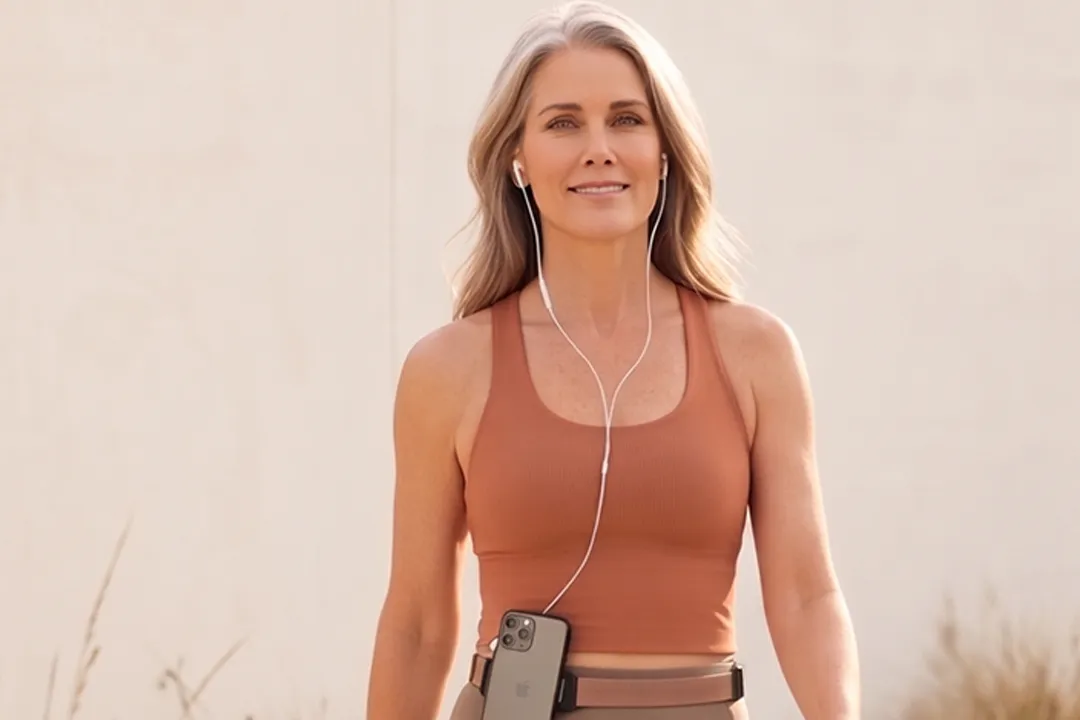
Walking is having a moment.
Not the regular kind — the workout kind. The kind that shows up on TikTok with names like 12-3-30, Japanese walking, hot girl walks and let’s not forget about the weighted vest, of course! The kind that lives next to spin classes and Pilates and barre on the list of things grown women actually do for their bodies.
This is not an accident. There’s a generation of women — many of them in their 40s and 50s — quietly figuring out that the workouts they did in their 20s and 30s may not be landing the same way anymore. The HIIT classes leave them wrecked for three days. The long runs make their knees scream. The boot camps that used to feel energizing now feel like a tax on a body that’s already paying enough taxes.
And so they’re walking. With purpose. With structure. With a coach in their ears.
This is your guide to all of it. What coached walking actually is. Why it matters now. How to build a weekly practice that doesn’t crush you. And how to take the trends you’ve seen — 12-3-30, weighted vests, Japanese walking, hot girl walks — and turn them into something that fits a body in its second act.
It’s long, because the topic is big. Skip around as you need to. Come back when you need it.
What coached walking actually means
Here’s the easiest way to explain it: coached walking is like a cycling class, but walking.
Imagine the structure of a Peloton class. A coach in your ears. A warmup. Intervals with clear targets. Music that builds. Recovery sections. A finish line. Now take all of that, and put it on a walk — outside, on a treadmill, on a walking pad in your basement, on a hotel sidewalk while you’re traveling for work.
That’s coached walking. It is not a podcast you listen to while walking. It is not a meditation. It is a workout — with intervals, intensity targets, and structure — where the movement happens to be walking instead of cycling or running or jumping.
The category is still under-defined in mainstream fitness, which is part of why it needs explaining. The format is genuinely different from anything else in the landscape, and women over 40 are the people for whom it makes the most sense — for reasons we’ll get into.
In this guide, we’ll cover four formats that fit under the coached walking umbrella.
HILIT.
High-effort, low-impact training. Hard work without relying on running or jumping.
LISS.
Low-intensity steady-state walking. A real workout, despite the name. The recovery your nervous system has been asking for.
Weighted vest walking.
A simple way to add load, intensity, and muscular demand to a walk — useful, but not a substitute for strength training.
Interval walking.
Including the Japanese method that’s everywhere right now. Three minutes brisk, three minutes recovery, repeated.
Each one earns its place in a weekly practice. None is the whole answer. The point is to know which is which, and when to reach for what.
Why your 40s and 50s change everything
You can feel it before anyone explains it to you: the workouts you used to do are not landing the way they used to.
Here’s what’s happening, in plain terms.
For many women, the hormonal background of the 20s and 30s is more predictable than it becomes during the menopause transition. Estrogen influences muscle repair, bone remodeling, connective tissue, metabolism, sleep, and how the nervous system responds to stress.
Somewhere in your late 30s and early 40s, that background starts to shift. Estrogen and progesterone begin fluctuating in ways that don’t show up on a chart but do show up in your training. Recovery may take longer. Stress, sleep disruption, and training load can start to stack differently. Your body’s response to the same workout you did three years ago can be different.
This is not a problem to solve. It’s a body in a different phase of its life, and it asks for a different training approach.
Dr. Stacy Sims — an exercise physiologist whose work has helped popularize a women-specific approach to training — frames this clearly: many women in perimenopause and beyond benefit from training that emphasizes strong, well-recovered stimuli, real strength work, and adequate fueling. Her framework is influential, though not every recommendation is settled science or right for every woman.
For some women, piling on long, medium-hard cardio several days a week stops feeling productive — especially when sleep, stress, fueling, and recovery are already strained. The issue isn’t that moderate cardio is bad. It’s that every session needs a job: build aerobic base, create intensity, support recovery, or maintain consistency.
The new playbook tends to look like this:
- Shorter, harder bursts (intervals, HILIT) instead of relying only on long, moderate cardio
- Real strength work — heavy enough to matter
- Genuine recovery — not just rest days, but parasympathetic-activating activity
- Less impact on joints and connective tissue that don’t recover the way they used to
If you’ve been running yourself into the ground in 5am boot camps and wondering why you feel worse than you did at 35 — this is often part of why. Your old workouts didn’t fail. Your body changed, and the workouts didn’t change with it.
This is the case for walking workouts. Done well, they hit a lot of what the new playbook asks for: real intensity is available (intervals, weighted vests), impact is near zero, recovery cost is manageable, and they fit into the life of a woman who has actual responsibilities.
HILIT — the format you’ve been waiting for
If you only learn one new acronym from this guide, make it this one.
HILIT stands for high-intensity, low-impact training. The goal is to preserve the useful part of intensity — harder breathing, higher heart rate, stronger metabolic demand — while reducing the joint pounding that comes with running, jumping, or bootcamp-style intervals.
Similar goal, lower impact: create a hard cardiovascular and muscular stimulus without relying on pounding or jumping.
In a walking context, HILIT looks like this: brisk walking pushed up against an incline, or fast walking with a weighted vest, or sprint-walking intervals at a pace that has you breathing hard but not hammering your joints. Your heart rate can climb into a genuinely hard zone — especially with incline, speed, or load — without requiring running or jumping.
For women over 40, HILIT is, frankly, the format that should have been taken seriously twenty years ago. It captures the parts of intensity training that travel well — better cardiovascular fitness, improved insulin sensitivity, and a stronger signal to preserve muscle when paired with strength training and adequate protein — without the recovery cost that high-impact training inflicts on aging joints and connective tissue.
It’s not “easier” than HIIT. A real HILIT session will leave you panting. It’s just gentler on the structures of your body that have been with you the longest.
LISS — the recovery you didn’t know you needed
LISS stands for low-intensity, steady-state walking. The name makes it sound like a beginner’s workout, which it absolutely isn’t.
LISS is the walking equivalent of a slow, conversational pace held for 30 to 60 minutes. Your heart rate stays in a low aerobic zone. You can talk in full sentences. It feels almost too easy.
Here’s what it actually does: it can help shift you toward a more parasympathetic, down-regulated state — the rest-and-digest side — while still delivering aerobic benefit. It restores you. It clears the residue of harder workouts and harder days. For women whose nervous systems feel like they’re already running hot from stress, sleep loss, and hormonal changes, LISS can be a powerful recovery tool.
This is the category Spanno calls Self Care — slow walks, recovery walks, nervous-system walks, grief walks, the Sunday Reset. They’re not “easy” workouts. They’re a different kind of work. The work of slowing down on purpose, of teaching a stressed body how to come back to baseline, of building the recovery infrastructure that lets the harder workouts actually deliver.
If you’ve been training hard and still feel terrible, the missing variable is almost always real recovery. LISS is one of the cleanest ways to add it.
Weighted vest walking, decoded
The weighted vest is having its moment. Every fitness influencer over 40 seems to be wearing one. There’s a reason — and also a little overclaiming.
A weighted vest makes walking harder in a straightforward way: you’re moving more mass. Heart rate may rise, breathing gets heavier, and your legs, hips, and core have to do more work for the same route. That’s a valuable training stimulus, particularly if you walk often and want each walk to do more.
Where the marketing gets ahead of the evidence is bone density. Bone responds best to high-enough mechanical strain — progressive resistance training, impact, jumping, hopping, and other loading strategies when appropriate. A vest can add load to a walk, but walking is still a relatively smooth, low-impact movement. That means vest walking is best treated as a useful supplement, not a replacement for the bone-building inputs women need in midlife: progressive strength training, appropriate impact or plyometric work when safe, adequate protein and minerals, and medical guidance when bone density is already a concern.
Think of the vest as a difficulty dial for walking — not a bone-density insurance policy.
Practical notes on getting started:
- Start at 4–8 pounds for the first few weeks, even if you feel like you can handle more
- Build gradually toward 5–10% of body weight for most fitness walking; some experienced walkers go higher, but heavier isn’t automatically better
- Use it on flat walks first; introduce inclines and intervals only after your shoulders and core have adapted
- Properly fitted vests sit close to the torso — bouncing ones cause neck and shoulder strain
The weighted vest is one of the simplest ways to make a walk more demanding — but it amplifies the walk you’re already doing. It does not replace strength training, impact work, or smart progression.
Interval walking — the Japanese method
You’ve seen it on social media: Japanese walking. It sounds exotic, but the idea is straightforward and the science is real.
The format is also called Interval Walking Training (IWT), and it was developed by researchers at Shinshu University in Nagano, Japan, more than two decades ago. The protocol: walk briskly for 3 minutes, walk slowly for 3 minutes, repeat for 30 minutes total. That’s it. Five rounds, twice the variety, half the boredom.
The published research is genuinely impressive. Across multiple controlled studies, interval walking produced greater improvements in aerobic capacity, leg strength, and blood pressure than steady walking — in some comparisons, despite similar or lower total walking volume. The intervals do real work that flat-paced walking simply doesn’t.
What makes IWT particularly suited to women over 40 is the recovery built into the structure. The 3 minutes of slow walking aren’t filler — they’re how your nervous system catches up between bursts. You get the hormetic stress of intervals (good) without the same recovery cost many people associate with full HIIT.
A few notes:
- The “brisk” pace should be hard enough that you can talk in short sentences, not full ones
- The slow pace is recovery, not stopping — keep moving
- Four times per week is the volume the original Shinshu studies used
- Outside or treadmill both work; the interval structure is what matters
If you already have a basic walking habit and want to add structure, IWT is one of the cleanest places to start. The structure is simple enough to remember, the time commitment is manageable, and the benefits show up within a few weeks.
The trends, honestly
Walking has more viral trends right now than there are weeks in the year. A short field guide to what’s worth your time.
12-3-30
The treadmill protocol where you walk at 3 mph on a 12% incline for 30 minutes. Created by influencer Lauren Giraldo around 2020, viral ever since. The science: incline walking is a real cardiovascular and lower-body workout. For many people, 12-3-30 functions like a low-impact, moderate-to-hard incline workout.
The honest assessment: 12-3-30 is good — but for many women over 40, the original prescription is too aggressive on day one. A 12% incline is genuinely steep, and starting there can flare up knees, hips, or lower backs. The smarter approach is to start at 4–6% incline, build to 8–10%, and reach 12% only when your body is consistently telling you it’s ready. The structure is excellent. The starting point is negotiable.
Hot girl walks
The viral concept: a long, intentional walk that’s about confidence, mental clarity, and energy as much as exercise. Originally a TikTok thing; now a category.
The honest assessment: hot girl walks are vibes, not training. They’re great. They’re not a workout in the structured-stimulus sense, but they’re an excellent on-ramp for women who’ve fallen out of a movement habit. The mistake is treating them as your only fitness — they usually don’t deliver the intensity or strength stimulus your body also needs in this phase of life. Pair them with structured work.
Weighted vest walking
Already covered above. This trend is useful, but it works best when framed correctly: as a way to make walking more demanding, not as a replacement for strength training or bone-specific work.
”Cozy cardio”
A subset of the broader walking renaissance — slow, easy walks with deliberate pleasure (good music, a podcast, a comfortable space). Functionally similar to LISS. Genuinely valuable as a recovery modality and a way to make movement non-aversive. Not enough on its own.
Rucking
Walking with a weighted backpack instead of a vest. Heavier loads (often 20–30 pounds) at slower paces. For women over 40, rucking can be excellent — but because backpacks load the body differently than vests, start lighter than you think and watch for neck, shoulder, low-back, hip, or foot symptoms. If your vest practice is solid, rucking is the natural progression.
Walking is not a single thing.
The trends are different applications of the same underlying tool.
Knowing which is which lets you build a practice instead of chasing whatever’s on your feed this week.
Building a weekly walking practice
This is the part most articles skip. You don’t need another workout — you need a week that fits together.
Here’s a sample week designed for a woman in her 40s or 50s who is reasonably fit, has access to a treadmill or outdoor walking space, and wants to build a sustainable walking practice. Adjust to your reality.
This is not a beginner week. If you’re just starting, cut it in half: two easy walks, one structured walk, and one strength session. Build from there.
| Day | Session | Duration | Why |
|---|---|---|---|
| Monday | Interval walking (Japanese method or HILIT intervals) | 30-40 min | Real intensity to start the week |
| Tuesday | LISS or recovery walk | 30-45 min | Active recovery, parasympathetic activation |
| Wednesday | Weighted vest walk, flat or rolling terrain | 30-40 min | Metabolic + muscular load |
| Thursday | Strength training (separate from walking) | 30-45 min | Non-negotiable in this phase |
| Friday | LISS or hot girl walk | 30-60 min | Pleasure, mood, recovery |
| Saturday | HILIT (incline intervals or weighted intervals) | 30-45 min | Hardest session of the week |
| Sunday | Long, slow walk | 45-60 min | Restoration, nervous system reset |
A few principles inside this framework:
- Two harder days, two easier days, one to two strength days, two flexible days. The hard days aren’t back-to-back. Two strength days is the long-term goal for most women.
- Strength training is in here on purpose. Walking is necessary, not sufficient. Bone density and lean muscle mass require resistance work.
- No more than 2–3 high-intensity sessions per week. More than that, in this phase of life, tips into chronic stress for many people. Your body adapts to the stimulus you actually recover from.
- The long Sunday walk is the most underrated session. It’s where your nervous system gets reset for the week ahead.
This is a starting framework, not a prescription. Your body will tell you what to adjust. Listen.
Common mistakes.
A short list of the things that derail women in this phase of life.
Doing only one type of walking.
All HILIT all the time, or all hot girl walks all the time. Both fail differently. The whole point of a practice is that the formats balance each other.
Skipping strength training.
Because walking feels like enough. It feels like enough. It isn’t. Your skeleton and your muscles need both.
Comparing this season to your 30s.
You won’t drop the same weight in the same way. You won’t recover from the same workouts. The metric that matters now is how you feel across a month — energy, sleep, mood, capacity.
Going too hard, too often.
The single most common mistake. Under-recovered training can hold you back even when you’re convinced more is more. Sleeping worse, recovering slower, feeling progressively flatter — that’s the signal.
Going too easy, too consistently.
The opposite mistake, and quieter. If every walk is conversational, your body has no reason to adapt. Some real intensity helps drive cardiovascular and metabolic adaptation; for bone and muscle, pair walking with progressive strength training.
Forgetting walking can be a workout.
Cultural conditioning has women treating walking as not-quite-real exercise. It is. The research is clear that walking counts — and that it can be meaningfully trained. Take it seriously and it will pay you back.
Where Spanno fits
Everything in this guide is what we built Spanno around.
Spanno is coached walking — audio-led workouts that turn ordinary walks into structured training sessions. Four categories that map to what your body actually needs:
Move.
HILIT and high-effort interval walks. Your hardest sessions.
Self Care.
LISS, nervous-system walks, recovery. The sessions that make the rest possible.
Strengthen.
Weighted vest walks, incline work, and strength-forward walking sessions for days you want more load.
Thrive.
Sessions designed with women 40+ in mind — balancing intensity, recovery, and sustainable progression. The series we’re proudest of.
If you want a place to start: download Spanno and try the welcome walk. It’s free. There’s no upfront sign-up — just put in your headphones and walk. If it works for your body, it’ll show you what it can do in about 20 minutes.
Frequently asked questions.
What is coached walking? +
Coached walking is an audio-led walking workout — like a cycling class, but on a walk. A coach guides pace, intensity, and intervals through your headphones, turning a regular walk into a structured training session. Spanno's sessions are designed with women over 40 in mind.
What is HILIT? +
HILIT stands for High Intensity Low Impact Training. The goal is to deliver a hard cardiovascular and muscular stimulus — through low-impact modalities like incline walking, weighted vest work, and interval walking — without relying on running, jumping, or bootcamp-style movements. For women over 40, HILIT can preserve much of the benefit of intensity training while reducing the recovery cost on joints, tendons, and connective tissue.
What's the difference between HILIT and HIIT? +
Both aim to push your heart rate into a demanding zone, but the impact is different. HIIT typically includes plyometrics, running, jumping, and other high-impact movements. HILIT pursues a similar cardiovascular and muscular stimulus through low-impact modalities like incline walking, weighted vest work, and interval walking. For women over 40, that means much of the benefit of intensity training with less recovery cost on joints, tendons, and connective tissue.
Is walking enough exercise during perimenopause? +
Walking alone usually isn't the whole picture — but structured walking that includes intervals, weighted-vest work, and recovery sessions, paired with progressive strength training, can be the foundation of a complete fitness practice during perimenopause. Many women in their 40s and 50s benefit from training that emphasizes well-recovered intensity, real strength work, and adequate fueling.
Do I need a weighted vest? +
You don't need one to start. A weighted vest can add useful metabolic and muscular load to a walk, making it meaningfully harder for the same time on your feet. It's best used as a way to amplify a walking practice — not as a stand-alone bone-density solution. For bone, pair walking with progressive strength training, appropriate impact work when safe, adequate protein and minerals, and medical guidance when bone density is a concern. If you do use one, start with 4–8 pounds, build gradually toward 5–10% of body weight, and let the vest sit snug against your torso so it doesn't bounce.
How often should I walk? +
For a structured walking practice, four to six sessions per week is a reasonable target for many people. Two of those can be harder (intervals, HILIT, or weighted vest), two easier (LISS, recovery), and one or two flexible. Pair this with at least one to two strength training sessions per week — two is the long-term goal for most women.
Can I do this if I'm new to exercise? +
Yes — walking is the most accessible entry point in fitness, and the coached structure removes the guesswork. Start with shorter sessions (15–20 minutes), prioritize easy paces for the first few weeks, and add intensity slowly. Build a basic walking habit first, then layer on structure.
Is the 12-3-30 workout good for women over 40? +
The structure is good. The starting prescription — 12% incline at 3 mph for 30 minutes — is too aggressive for many people on day one. Start at 4–6% incline, build to 8–10%, and reach 12% only when your body confirms it's ready. Done with progression, 12-3-30 functions as a low-impact, moderate-to-hard incline workout. Done as advertised on day one, it can flare up knees, hips, and lower backs that aren't ready for that load.
What's the Japanese walking method? +
A 30-minute interval walking protocol developed by researchers at Shinshu University in Japan: alternate 3 minutes of brisk walking with 3 minutes of slower recovery walking, repeated five times. Studies have shown it produces meaningful improvements in aerobic fitness, leg strength, and blood pressure compared with steady-pace walking. The recovery intervals build adequate parasympathetic time into the structure, which makes it well-suited to people who don't recover well from full HIIT.
How is Spanno different from other walking apps? +
Most walking apps track your steps. Spanno *coaches* your walks — audio-led sessions with structure, intervals, and intensity targets, designed with women 40+ in mind. The Thrive category is purpose-built for this stage, balancing intensity, recovery, and sustainable progression.
Coached walking, on iOS.
Spanno is the audio coach for women over 40. Real intensity, no impact, no guesswork. Free to start.